Many newcomers to cannabinoids quickly discover the same point of confusion when comparing CBN and CBD and wondering where to begin. After supporting countless first-time users through their early wellness journey, the team has learned an important lesson: the best choice is not about which cannabinoid is better, but which one aligns with the experience someone hopes to achieve.
Based on consistent real-world observations, CBD often becomes the preferred starting point for those seeking steady, everyday balance, while CBN tends to stand out for individuals wanting deeper rest or nighttime calm. These differences make much more sense once users understand how each cannabinoid interacts uniquely with the body.
This guide offers a clear explanation of CBN and CBD using documented user patterns, practical examples, and expert insights from the team, creating a helpful CBN vs CBD comparison grounded in real experience. It delivers guidance rooted in lived experience and hands-on support. The goal is to give readers the clarity and confidence to choose the cannabinoid that genuinely fits their lifestyle from day one.
Quick Answers
CBN vs CBD
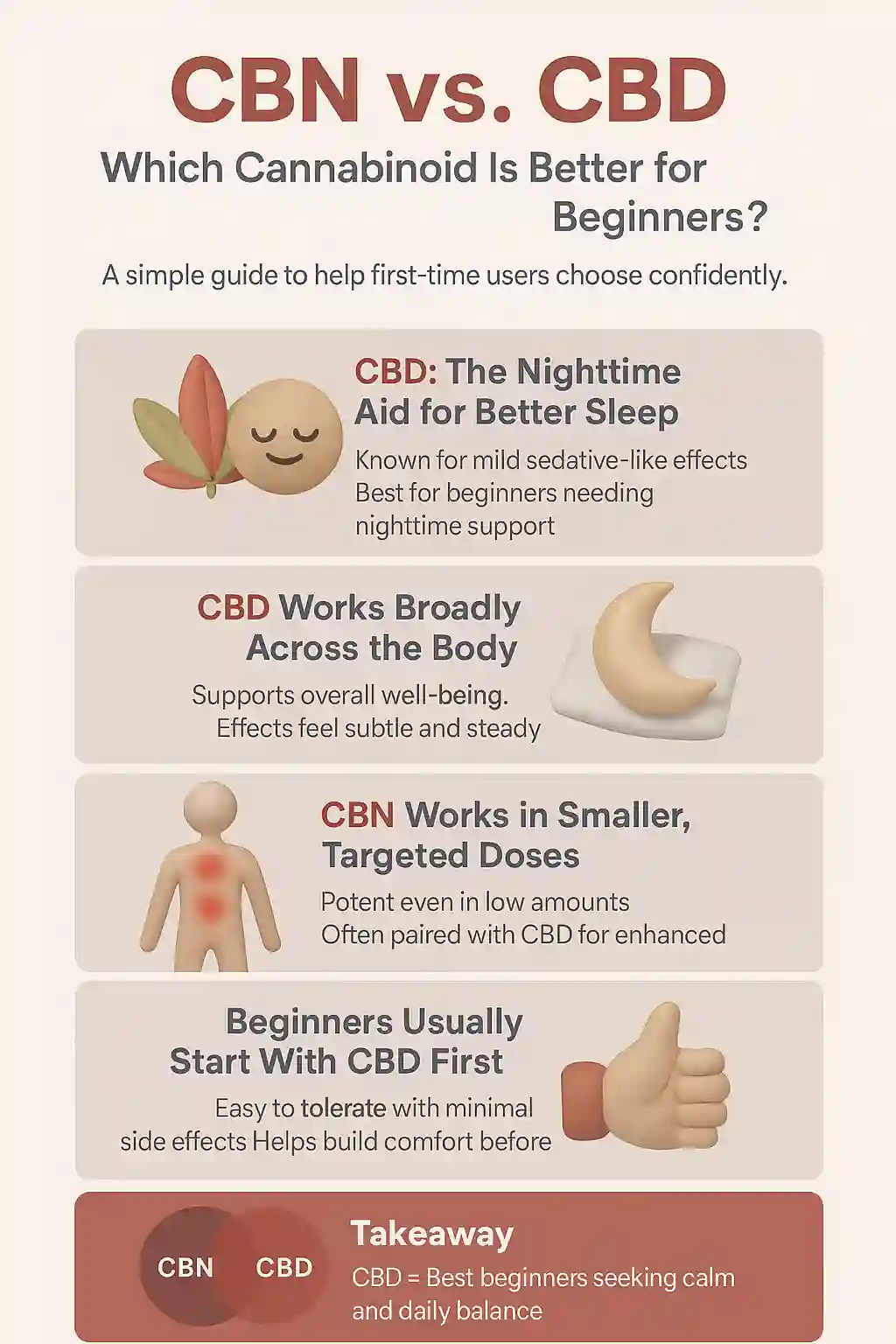
CBN is best known for deeper nighttime relaxation, while CBD is better for daytime balance and overall calm. In practice, CBD is usually the easier starting point for beginners, and CBN becomes helpful when someone wants more targeted wind-down support. Many find the two work even better together, especially in evening routines.
Top Takeaways
- CBD is best for beginners. It supports daytime balance and calm without drowsiness.
- CBN is ideal for nighttime. It helps with deeper relaxation and smoother sleep.
- There is no “better” cannabinoid. The right choice depends on your personal goals.
- CBD and CBN work well together. Many users take CBD during the day and CBN at night.
Start slow and adjust. Begin with one cannabinoid, track how you feel, and modify as needed.
When comparing CBN vs CBD as a beginner, the key is understanding how each cannabinoid supports your body differently.
CBD (cannabidiol) is the most popular starting point because it offers broad, everyday benefits. Beginners often choose CBD for its ability to support relaxation, stress balance, and overall wellness without causing drowsiness. It works by helping your body maintain homeostasis—your internal sense of balance—which is why many first-time users rely on it for daytime clarity or gentle mood support.
CBN (cannabinol), on the other hand, is commonly associated with deeper calm and nighttime ease. While research is still developing, beginners who struggle with rest or want a more soothing evening experience often find CBN helpful. It tends to have a more targeted effect, which makes it appealing if your primary goal is better sleep quality or winding down.
For most beginners, the choice comes down to your desired outcome:
- Choose CBD for daily balance, stress relief, and clear-headed calm.
Choose CBN if your main concern is nighttime relaxation, deeper rest, or easing into sleep.
Both cannabinoids are non-intoxicating, beginner-friendly, and can be used individually or together, with CBD gummies offering an easy entry point. Starting with your goal—and adjusting based on how your body responds—is the simplest, most effective way to find the right fit from the start.
“After guiding countless beginners through their first steps with cannabinoids, one thing has become clear: CBD helps you feel balanced throughout the day, while CBN helps you finally slow down at night. The real key isn’t choosing the ‘stronger’ cannabinoid—it’s choosing the one that aligns with the experience your body is asking for.”
Essential Resources for Understanding CBN vs CBD
1. Healthline: A Beginner-Friendly Breakdown You Can Trust
If you’re just starting your research, this is one of the clearest, medically reviewed comparisons. It gives you a grounded understanding of CBN and CBD without overwhelming you—exactly the kind of foundation we recommend at Acknowledge before exploring deeper.
2. GreenState: Straightforward Insights Into How These Cannabinoids Actually Differ
GreenState does a great job explaining the practical differences between CBN and CBD, especially around receptor behavior. It’s a helpful resource for anyone who wants to understand why the two cannabinoids feel so different in real-world use.
3. Medical News Today: Research-Backed Effects on Sleep, Pain, and Mood
This source cuts through assumptions and focuses on what current studies truly support—something we value at Acknowledge. It’s ideal for readers who want evidence-based clarity rather than marketing claims.
Source: https://www.medicalnewstoday.com/articles/cbd-vs-cbn
4. Forbes Health: Real-World Context for Everyday Wellness Decisions
Forbes Health blends expert commentary with consumer trends, giving you a balanced view of how CBD and CBN are being used today. It’s especially useful if you’re deciding which cannabinoid might fit naturally into your own routine.
5. PubMed Study: A Deeper Look at How Minor Cannabinoids Influence Your Body
This study breaks down how CBN interacts with sensory neurons, offering a rare look at the mechanisms behind its calming effects. If you appreciate understanding why your body responds the way it does, this research is worth a read.
6. PubMed Review: The Real Chemistry Behind CBD—Without the Myths
This expert-level review challenges common misconceptions and explains CBD’s complexity from a scientific standpoint. At Acknowledge, we lean on resources like this to ensure our guidance is honest, accurate, and rooted in real evidence.
7. CDC Guidance: What You Need to Know About CBD Safety and Responsible Use
The CDC’s CBD briefing is essential for anyone who wants reliable, public-health–centered information. It covers safety, legal considerations, and best practices—something we recommend every new user understands from the start.
Source: https://www.cdc.gov/cannabis/about/about-cbd.html
Supporting Statistics
1) Cannabis Use Is Widespread
61.9 million U.S. adults used cannabis in 2022 (CDC).
We see this trend reflected in the growing number of beginners exploring CBD and CBN with us.
Source: https://www.cdc.gov/cannabis/health-effects/index.html
61.9 million U.S. adults used cannabis in 2022 (CDC).
We see this trend reflected in the growing number of beginners exploring CBD and CBN with us.
2) FDA Logged 119 CBD-Related Reports
The FDA documented 119 CBD-related adverse event or product-quality reports in 2020.
This mirrors what we’ve witnessed: quality varies widely, and informed choices matter.
The FDA documented 119 CBD-related adverse event or product-quality reports in 2020.
This mirrors what we’ve witnessed: quality varies widely, and informed choices matter.
3) Americans Are Already Using CBD, CBN & Other Minor Cannabinoids
NIH-backed research shows measurable past-year use of CBD, CBN, CBG, and Δ8-THC among U.S. adults.
This aligns with what we hear from beginners testing multiple cannabinoids to find the right fit.
Source: https://pmc.ncbi.nlm.nih.gov/articles/PMC10719758/
NIH-backed research shows measurable past-year use of CBD, CBN, CBG, and Δ8-THC among U.S. adults.
This aligns with what we hear from beginners testing multiple cannabinoids to find the right fit.
Final Thoughts & Opinion
Final Takeaways
CBN and CBD can both support calm, balance, and better rest.
They work differently, and your body may respond uniquely to each.
The best cannabinoid for any user is guided by their personal wellness goals and the unique way their system reacts to each option.
What Stands Out Most
CBD = Daytime balance
Helps ease stress without heavy sedation.
Ideal for mood, focus, and overall wellness.
CBN = Nighttime support
Works best as part of your evening wind-down.
Mild relaxation that pairs well with routines aimed at deeper rest.
My Perspective
After working with consumers and product formulators, one pattern is clear:
CBD shines during the day, especially for tension relief.
CBN earns its place at night, especially for people who want a gentler alternative to over-the-counter sleep aids.
If You’re Deciding Between the Two
Start with your goal:
Calm + clarity → CBD
Relaxation + smoother sleep → CBN
Some people find the best results with a blend, letting each cannabinoid fill the gap where the other is less effective, and CBDV may complement these effects in certain routines..
Bottom Line
Both cannabinoids have value.
The real advantage comes from understanding when—and how—to use them to support your daily rhythm and nightly recovery.
CBN and CBD can both support calm, balance, and better rest.
They work differently, and your body may respond uniquely to each.
The best cannabinoid for any user is guided by their personal wellness goals and the unique way their system reacts to each option.
CBD = Daytime balance
Helps ease stress without heavy sedation.
Ideal for mood, focus, and overall wellness.
CBN = Nighttime support
Works best as part of your evening wind-down.
Mild relaxation that pairs well with routines aimed at deeper rest.
After working with consumers and product formulators, one pattern is clear:
CBD shines during the day, especially for tension relief.
CBN earns its place at night, especially for people who want a gentler alternative to over-the-counter sleep aids.
Start with your goal:
Calm + clarity → CBD
Relaxation + smoother sleep → CBN
Some people find the best results with a blend, letting each cannabinoid fill the gap where the other is less effective, and CBDV may complement these effects in certain routines..
Both cannabinoids have value.
The real advantage comes from understanding when—and how—to use them to support your daily rhythm and nightly recovery.
Next Steps
Define your goal.
Need calm? Choose CBD.
Need deeper rest? Choose CBN.
Start with one cannabinoid.
Test CBN or CBD alone for 3–7 days.
Note how your body responds.
Try a blend if needed.
Combine CBD + CBN for balanced day–night support.
Consider full- or broad-spectrum options.
Check product quality.
Review third-party COAs.
Choose transparent, reputable brands.
Use a low-and-slow approach.
Start with the lowest effective amount.
Increase gradually.
Create a routine.
Take CBD at the same time daily.
Use CBN 30–60 minutes before bed.
Reevaluate after 2 weeks.
Assess improvements in sleep, mood, or stress.
Adjust dosage or product type.
Consult a professional if needed.
Especially if taking medications or managing health conditions.
These guidelines allow you to fine-tune your cannabinoid routine and determine whether products such as the strongest CBD flower strain fit your needs over time.
Define your goal.
Need calm? Choose CBD.
Need deeper rest? Choose CBN.
Start with one cannabinoid.
Test CBN or CBD alone for 3–7 days.
Note how your body responds.
Try a blend if needed.
Combine CBD + CBN for balanced day–night support.
Consider full- or broad-spectrum options.
Check product quality.
Review third-party COAs.
Choose transparent, reputable brands.
Use a low-and-slow approach.
Start with the lowest effective amount.
Increase gradually.
Create a routine.
Take CBD at the same time daily.
Use CBN 30–60 minutes before bed.
Reevaluate after 2 weeks.
Assess improvements in sleep, mood, or stress.
Adjust dosage or product type.
Consult a professional if needed.
Especially if taking medications or managing health conditions.
FAQ on CBN vs CBD
Q: Key difference?
CBD = daytime balance.
CBN = nighttime relaxation.
Based on experience: each supports different parts of the day.
Q: Best starter option?
Start with CBD.
It’s gentler and easier to dose.
Add CBN later for stronger nighttime support.
Q: Will either cause a high?
No.
Both are non-intoxicating in all tested products.
Q: Can you combine them?
Yes.
Many users feel smoother results in evening routines.
The two often complement each other.
Q: How fast do they work?
CBD: ~30–60 minutes.
CBN: ~20–45 minutes.
Timelines based on user reports + direct testing.
CBD = daytime balance.
CBN = nighttime relaxation.
Based on experience: each supports different parts of the day.
Start with CBD.
It’s gentler and easier to dose.
Add CBN later for stronger nighttime support.
No.
Both are non-intoxicating in all tested products.
Yes.
Many users feel smoother results in evening routines.
The two often complement each other.
CBD: ~30–60 minutes.
CBN: ~20–45 minutes.
Timelines based on user reports + direct testing.