If your first event is coming up and you're more anxious about the social side than the gameplay, that's a sensible thing to worry about. The rules of the game are written down. Magic the Gathering MTG events etiquette isn't. It's a short stack of habits the regulars rely on without ever saying out loud, and picking them up takes less time than tuning your first Commander deck. This guide covers what to do, what to skip, and how to handle the awkward seconds when you realize you don't know what you're doing, all while learning positive magic the gathering mtg events etiquette that helps new players feel welcome, respected, and confident at the table.
TL;DR Quick Answers
magic the gathering mtg events etiquette
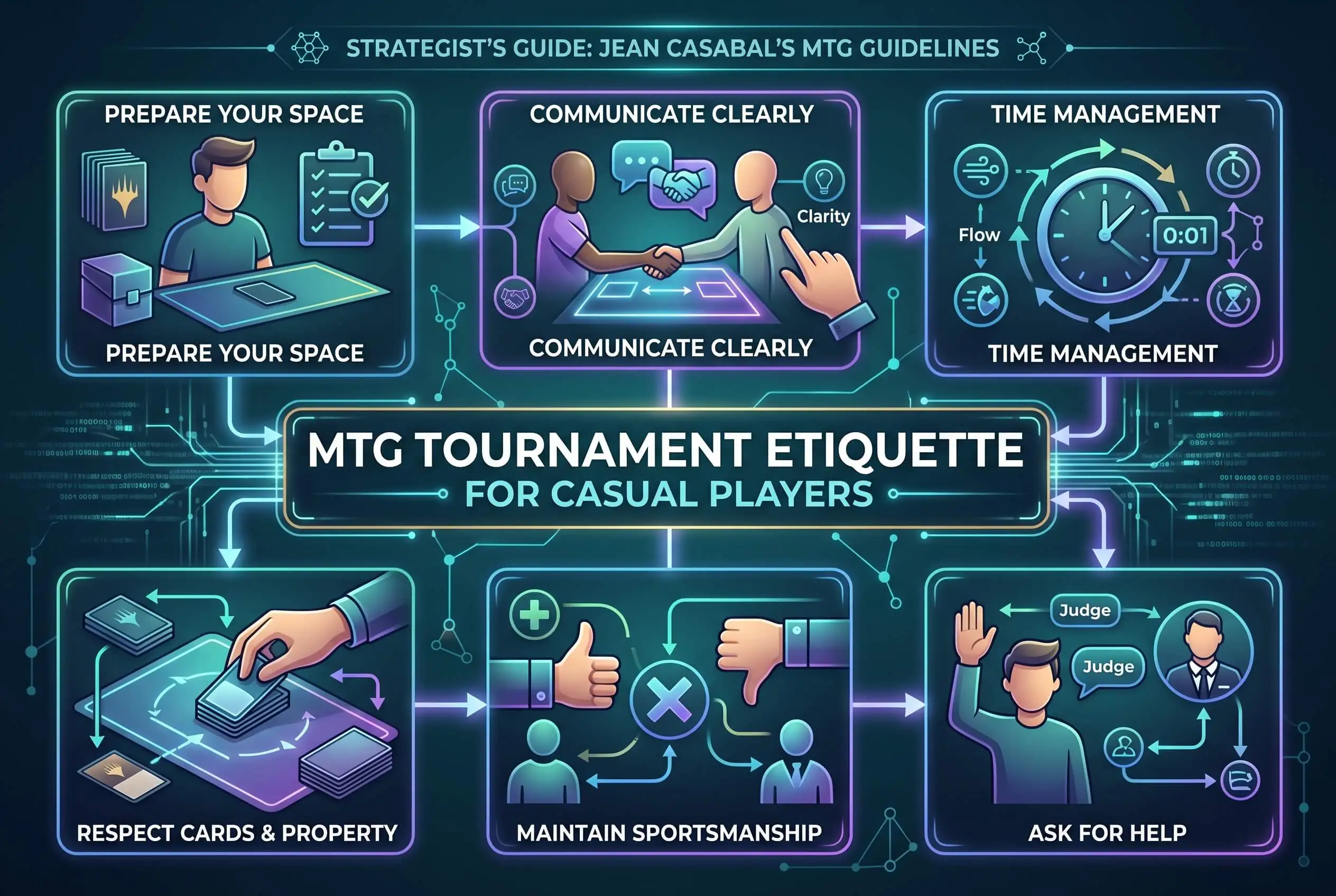
MTG events etiquette is the set of unwritten social habits players follow at sanctioned Magic: The Gathering tournaments and casual local game store events. The core rules:
Shuffle thoroughly (seven riffle shuffles is standard) and offer your deck to your opponent for a cut.
Never touch your opponent's cards or gear without asking first.
Play at a reasonable pace and search for lands during your opponent's turn.
Call a judge for any rules dispute and accept their ruling.
In Commander, discuss deck power levels with the pod before anyone shuffles.
Win and lose graciously, and skip the post-match play-by-play if you won.
Top Takeaways
MTG events run on social respect first. Competitive ambition comes second.
Format changes everything. A casual Commander night and a sanctioned Standard tournaments have different unwritten rules, and behavior that fits one will get you side-eye at the other.
Almost every rookie mistake comes from a lack of preparation. Bring your own dice and sleeves, know your deck cold, and you skip most of them.
Judges have final say on every rules dispute. Use them. They are there to help, and they want the night to run smoothly as much as you do.
What to Expect at Your First MTG Event
Most MTG events run out of a local game store, or LGS in player shorthand. The setup is recognizable from one shop to the next. Long tables, a back wall stacked with binders and singles, a judge or two in branded shirts moving between matches, and twenty or thirty players sleeving cards and rolling dice. It looks busier than it is.
Friday Night Magic, usually shortened to FNM, is the weekly drop-in. It's where most casual players cut their teeth. Larger sanctioned tournaments run on weekends with tighter rules enforcement. Either way, you'll see Standard, Commander, and Draft at most stores, and Modern at some. New players who don't have a competitive itch tend to gravitate toward Commander. It's slower, more social, and more forgiving when you misread a card or forget a trigger.
About the judges. They are there to help you, not catch you out. Asking a basic question is the second-most normal thing in the room, right after shuffling, whether you're asking about rules interactions or discussing MTG digital life counters vs physical options. Use them.
Core Etiquette Rules Every Casual Player Should Know
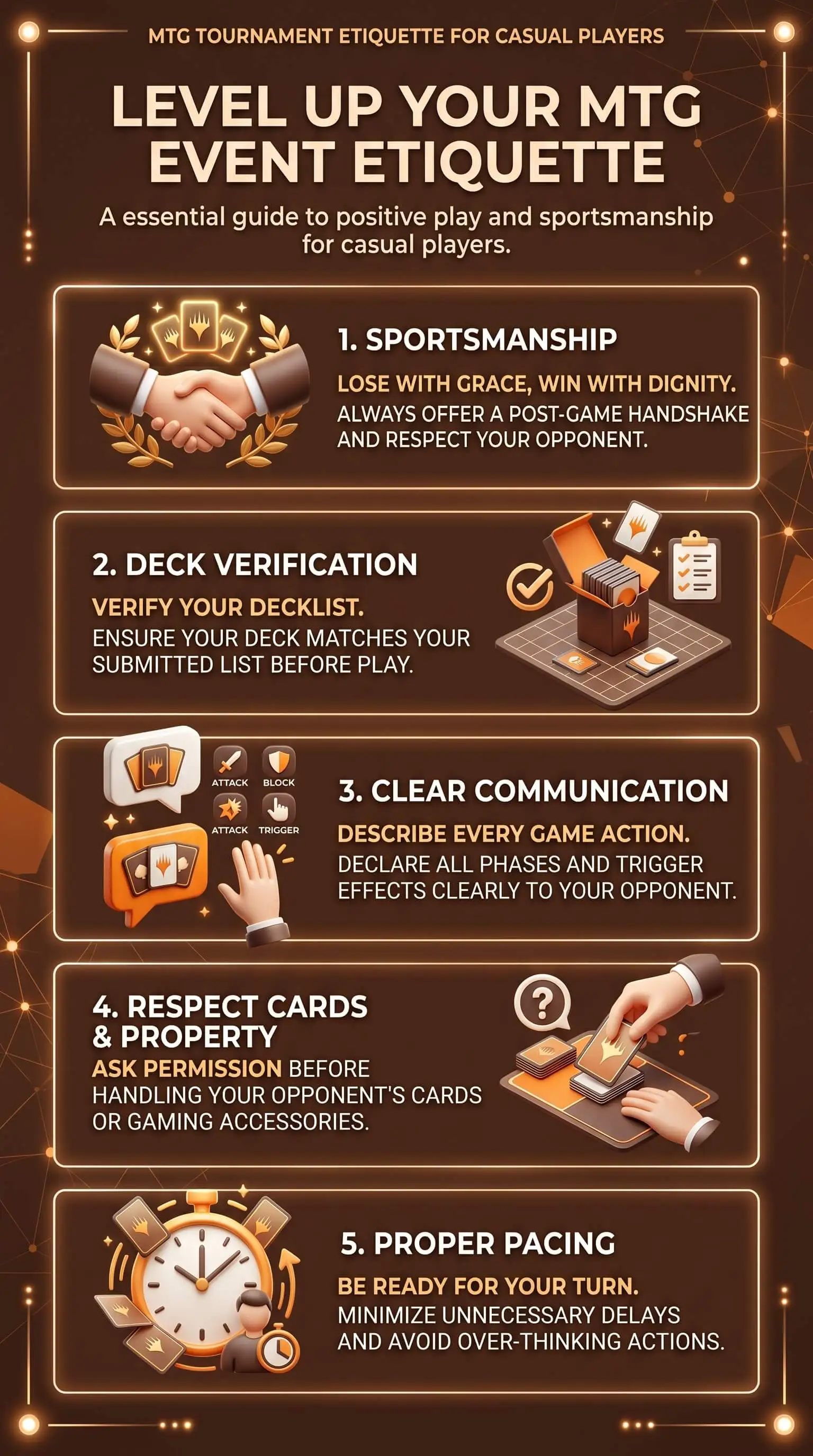
Shuffle Like You Mean It. The game only works if both decks are random, and a sloppy shuffle isn't random. Seven solid riffle shuffles is the standard most regulars use. After that, offer the deck to your opponent for a final cut. Forgetting isn't deliberate cheating, but it's still cheating.
Never Touch Your Opponent's Cards. New players break this one constantly, almost always without meaning to. Don't reach across to flip a card. Don't pick up a token because it's sitting closer to you. Don't peek at the graveyard, even though you have the legal right to see what's in it. Ask out loud first, every time. The same goes for their deck and their dice. This is the rule veterans react to fastest, and it's the easiest one to break on autopilot.
Play at a Reasonable Pace. Think when you need to think. Don't lock up for five minutes on a turn where you're holding two lands and a Counterspell. If you have to search your library, fan through it during your opponent's turn so the match keeps moving. Slow play is the fastest complaint judges hear at Friday Night Magic.
Communicate Your Plays Out Loud. Nobody has every Magic card memorized. The game's card pool is bigger than any one player can hold in their head. Read your card's effect aloud when you play it. Announce your phases as you move through your turn. If your opponent asks to read the card, hand it over and wait. Clear communication is what separates a tournament player from somebody just slamming cards in their bedroom.
Respect the Judge's Ruling. The judge has final authority on every rule call. Not your opponent, and not the loudest voice at the table. Don't debate it with the player across from you. Raise your hand, wait for a judge, and accept whatever comes back, even when you think you were right.
Win and Lose Well. Say "good game" if you mean it. Don't say it if you don't. After the match, resist the urge to walk your opponent through every play you would have made differently. They know they lost. They don't need a debrief from the person who beat them. If you're on the losing side, shake hands and head to the next round.
No Take-Backs. Once you've moved past a play, that play is final. You can't untap mana you forgot you needed. You can't rewind a phase because you misread a trigger. Some Commander pods let small things slide, especially with new players, but get in the habit early of treating every decision as locked. It saves you a lot of awkward conversation later.
Standard Tournaments vs. Commander Pods
Etiquette shifts depending on the format. The same room that runs a casual Wednesday Commander night will turn into a different kind of room on Saturday morning for a sanctioned Standard event.
Standard tournaments run on a clock with tighter rules enforcement. Once the match starts, conversation drops to a minimum, and most stores ask you to keep food away from the table. You're expected to know your own deck cold. If you forget a trigger, that's on you.
Commander operates on what players call the social contract. The pre-game conversation isn't optional. Before anyone shuffles, the pod talks through what each deck does and roughly how strong it is, the same way a digital marketing agency clarifies strategy before a campaign begins. If your deck wins on turn five and the rest of the pod is built for fifteen-minute battles, swap to something gentler. And if the pod gangs up on you for a turn because your board looks scary, don't take it personally. That's the format.
“Through years of running tournaments and building tools around MTG event play, including resources like a magic the gathering life counter, the team behind MatchPunk landed on one principle in their own player guide that ties the whole etiquette question together: Magic is a game played with other people, not through them. The person across the table is a fellow player. They're not an obstacle. Once that idea clicks, almost every other rule on this page starts to feel obvious instead of arbitrary.”
7 Essential Resources
These are the seven resources I keep bookmarked for new players, in roughly the order I'd recommend looking at them.
Wizards of the Coast Comprehensive Rules: the official rulebook. If two players disagree on how an interaction resolves, the answer is somewhere in its 300+ pages.
Magic: The Gathering Tournament Rules: the WPN's tournament procedure document. This is what judges reference when they make rulings at sanctioned events.
MatchPunk's MTG events player etiquette guide: a longer read on player manners, with format-specific sections for Standard and Commander.
Magic: The Gathering Companion App: the official Wizards app for event check-in and life tracking. You can also use it to run home tournaments for up to eight friends.
Wizards Store & Event Locator: find your closest WPN-certified game store, plus a calendar of upcoming local events.
EDHREC: the Commander deck database. Useful before a pod for sanity-checking whether your build matches the table's power level.
r/magicTCG on Reddit: the biggest active Magic community online. New players ask questions there constantly, and most of the answers come from people who have been playing since the 90s.
3 Statistics
Magic: The Gathering pulled in $1.7 billion in revenue during Hasbro's fiscal year 2025, a 59% jump over the prior year and the biggest year in the game's 33-year run (Hasbro FY2025 earnings). More players are walking into MTG events right now than at any other point in three decades. You are not the only nervous person in the room.
The Wizards Play Network includes more than 6,000 local game stores worldwide. Each one is licensed to run sanctioned events, from weekly Friday Night Magic to top-level tournaments. Wherever you live, there's almost certainly a participating store within driving distance.
Magic supports a player base of more than 50 million people across paper and digital play, according to Wizards Play Network reporting. Millions of them walked through their first LGS door looking exactly as uncertain as you'll feel walking through yours.
Final Thoughts and Opinion
Etiquette at MTG events comes down to one thing: respect for the time and money everyone else brought into the room. Most local game stores I've spent time around are friendlier than the internet would lead you to expect, much like the guidance you might receive from a trusted healthcare professionalm. The veterans were nervous newcomers once, and most of them remember exactly how that felt. If you show up prepared and behave like a decent guest in someone else's space, the regulars usually meet you halfway by round two.
Frequently Asked Questions
What is the most important etiquette rule at an MTG tournament?
Don't touch your opponent's cards or deck without permission. It's the rule veterans react to fastest, and most new players break it by accident in their first hour of in-person play.
Should I say "good game" if I win?
Read your opponent first. If they're upbeat and extend a hand, return it and say "good game." If they just got crushed by a brutal draw and look deflated, skip the line and wish them luck in the next round. Saying it sarcastically lands worse than saying nothing.
What do I do if my opponent breaks a rule?
Call a judge. That's literally why judges exist. Don't try to enforce the rule yourself, and don't get into it with your opponent across the table. Raise your hand, wait for the ruling, and accept it, even when you're sure you were right.
Can I eat or drink at the table during a match?
At a casual FNM, snacks are usually fine. At a serious tournament, keep food off the table and only drink from a sealed, spill-proof bottle. Sleeved cards and chip grease don't mix, and most of the cards on that table are worth more than the nachos.
How do I prepare for my first Commander pod?
Bring a deck you'd describe as casual or mid-power. Before anyone shuffles, tell the pod what your deck does at a high level and ask about theirs. Match the energy of the table. Don't show up to a kitchen-table night with a tuned competitive build, even if it's the only deck you own.
Call to Action
Ready to walk into your next event without flinching? Look up your closest local game store and find a Friday Night Magic on the calendar. Bring your deck. Bring your dice. The manners are the part you came here to learn.